ICAN’s Mission Five Steps for Sustainable Prevention of Sexual Violence in Conflict ICAN Partner AWAPSA: A Catalyst for Kenya’s First SGBV Court The War Against Ourselves: Afghan Women Peacebuilders’ Response to the Mental Health Crisis in Afghanistan Protecting Women Peacebuilders: The Front Lines of Sustainable Peace
Think Peace: Conflict Analysis of Al-Anbar Iraq: Security, Religion & Gender
Security, Religion and Gender in Al-Anbar Province, Iraq:
A focus group-based conflict analysis
By Ala Ali
Almost eleven years have passed since the US toppled Saddam Hussain’s regime, and Iraq still continues to struggle. In December 2013, Iraq national security forces stormed the private residence of the Iraqi Finance Minister, arresting several of his staff for supporting terrorism. This incident served as a trigger for sectarian violence throughout the Sunni triangle in southern Iraq – Al-Anbar Province. It was one of the areas that led peaceful demonstrations on February 2011, but subsequently witnessed the highest amount of sectarian violence, including government security force attacks on civilians.
The recent advancement of Islamic State of in Iraq and Syria (ISIS or Daesh) forces in Mosul and other areas in Iraq has caused great concern about the prospects of peace. Policymakers are scrambling to figure out an appropriate strategy to limit further advancement and prevent further security breakdown. Amidst this uncertainty, one thing is clear: preventing the further breakdown of the Iraqi state and the growth of violent extremism is a goal of international and regional actors, as well as Iraqi authorities. But ISIS’ advancement in Mosul is not a new phenomenon. ISIS has managed to gain strength in other areas within Syria and Iraq before. Studying patterns in these areas may help in identifying strategies on how to move forward to build a lasting peace in Iraq and in the region.
The following is a summary of a study of the conflict in Al-Anbar province. The findings may provide insight into the recent developments in Iraq, including explanations for the advancement of ISIS. Several key issues contributing to and sustaining conflict were identified through this research, as were points of entry for peace building which can be capitalized on to reduce tensions. Key themes include:
- Political & sectarian tensions
- Sense of citizenship
- Culture of dialogue
- International Community
- Rule of law & structural violence
- Armed groups
- Youth
- Gender & rights
- Recommendations for action
Related Posts
Race, Power and Peacebuilding aims to explore and to understand how racism manifests itself in the peacebuilding sector. This report has been produced by Peace Direct in collaboration with the Global Partnership for the Prevention of Armed Conflict (GPPAC), International Civil Society Action Network (ICAN) and United Network of Young Peacebuilders (UNOY).
ICAN Latest ICAN Updates Papers
This background paper for the High-Level Meeting on Financing for Peacebuilding was prepared by the International Civil Society Action Network (ICAN), Global Network of Women Peacebuilders (GNWP), Global Partnership for the Prevention of Armed Conflict (GPPAC), Kvinna till Kvinna, MADRE, and Women’s International League for Peace and Freedom (WILPF). The paper focuses on six structural barriers faced by diverse women peacebuilders in accessing funds to support their work. While acknowledging that existing solutions to mitigate challenges need to be further amplified and strengthened, this paper explores innovative avenues to transform the current system of peacebuilding financing to sustainably address the challenges faced by diverse women peacebuilders in the pursuit of inclusive and lasting peace.
ICAN Featured ICAN Latest ICAN Updates Innovative Peace Fund Papers Policy Advocacy
Recognizing the value and need to channel equitable resources to local women’s peacebuilding organizations (WPBOs) have been constant stipulations of the value of the Women, Peace, and Security (WPS) agenda since its inception at the turn of the 21st century. From the United Nations to its 193 member states, the desire and intent to support such organizations has increased over the years. But the chasm between donors’ good intentions and their political, financial, and administrative constraints has hampered the flow of funds to the grassroots women who need them the most.
ICAN Featured ICAN Updates Our Resources SBP Frameworks
This policy brief highlights key challenges impeding progress on the global PVE and SDG 16 agendas, underscoring how they are two sides of the same coin.
Exclude from RSS Our Resources PVE Thematic Reports
"Challenging Conventional Wisdom, Transforming Current Practices: A Gendered Lens" Sanam Anderlini's contribution to the newly published "Transformative Approaches to Violent Extremism", Berghof Handbook Dialogue Series 13 on Preventing Violent Extremism
G&E other resources ICAN Featured ICAN Updates Papers
This brief examines and reflects on existing efforts to enable the participation of civil society voices, notably women, in Yemen’s formal negotiations. And it provides practical recommendations to the U.S. administration and Congress on steps needed to reach peace in Yemen.
ICAN Featured ICAN Updates Our Resources Papers Peace Track Initiative
A gendered content analysis of nine NAPs, analyzing whether and how specific themes and target groups were discussed, including education, media, civil society, gender/ women, and human rights.
G&E other resources Papers
Images of women’s mass participation surprised Western observers and revealed the vibrant force of Yemeni women as influential, yet previously unrecognized, change agents.
Our Resources What The Women Say Briefs
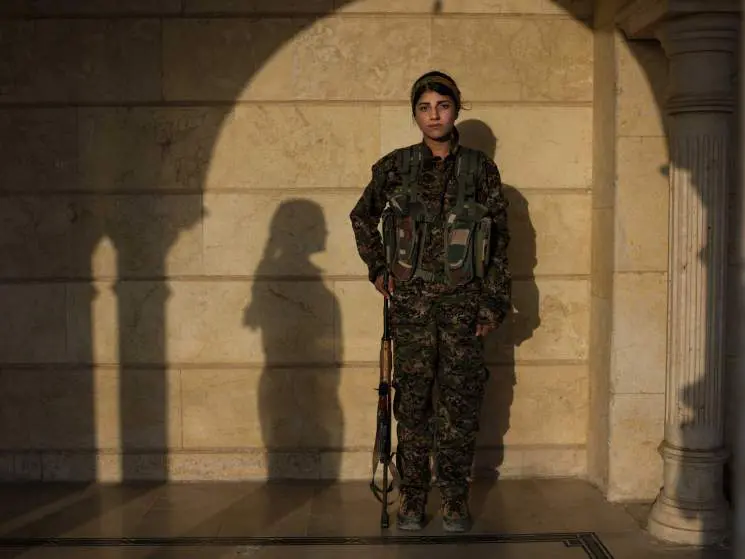
Respect the Dignity and Autonomy of Girls: Stop Recruitment of Girls into Militant Groups 16 year-old YPJ fighter Barkhodan Kochar from Darbasi, Syria.“The war influenced me a lot. Before joining YPJ, whenever I asked my family about politics, they’d say ‘that’s not your business, you’re just a girl’. But when I saw how the women […]
G&E other resources Papers