By Melinda Holmes
The second weekly virtual meeting of the Women’s Alliance for Security Leadership (WASL) was held on April 9, 2020. Members of WASL were joined by HRH the Countess of Wessex to continue the discussion of what women peacebuilders around the world are doing to respond to COVID-19. The conversation also revealed emerging trends in the way the pandemic is impacting peace and security, from reinforcing authoritarian practices to providing fuel for extremist narratives.
While this week saw positive developments in Yemen with a ceasefire and commencement of cyber-mediation between the warring parties, elsewhere governments and non-state armed groups alike are using the crisis for political gain. Political violence continues unabated in many places. In fact, some countries are using the pandemic as an excuse to criminalize the vital activities of civil society organizations by accusing them of spreading disinformation (because their awareness-raising activities may be against the official line) and release prisoners convicted of war crimes. Egypt and Libya have contributed medical personnel to the response in Italy, projecting confidence and competency to the outside world while villages at home remain without doctors and necessary medical equipment.
Indeed from Italy and the United States to Iraq and Sudan, COVID-19 is demonstrating the impact of decades of disinvestment in public infrastructure in favor of unbridled military spending. This is most visible in the lack of trained healthcare workers, equipment and supplies, yet the effects of this economic regime run far deeper. The lack of public education and low literacy, the precariousness of daily subsistence stemming from a prevalence of informal and day-labor, and poor internet connections and electricity supplies all inhibit response efforts and compliance with physical distancing measures.
Some countries are using the pandemic as an excuse to criminalize the vital activities of civil society organizations
At the same time, terrorist groups are capitalizing on fear and people’s increased online presence by spreading conspiracy theories and doomsday narratives. In Somalia (as in the United States and elsewhere), this and the slow advent of cases has resulted in people not taking the pandemic seriously, convinced that believers can’t get the virus. Yet, simultaneously non-state armed groups are also providing humanitarian relief and positioning themselves as saviors of the people. As political battles persist amid state failures in their response to the pandemic, a widespread lack of trust between people and government is being reinforced. The resulting political vacuum is being filled by both benevolent civil society and groups with ulterior motives.
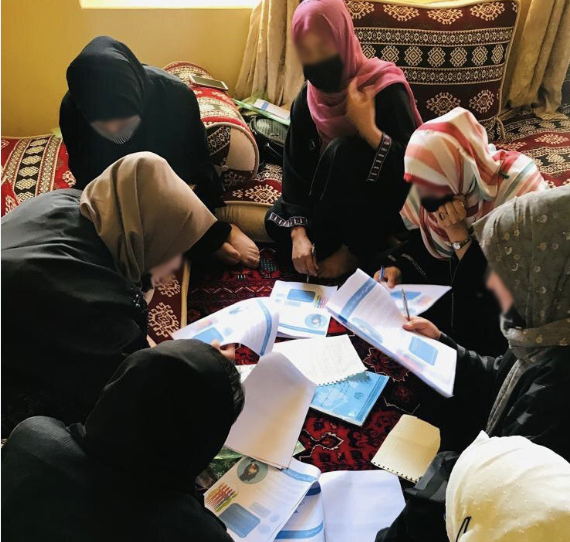
The shape we find our societies in as we emerge from the other end of this crisis will very much depend on who has the resources and support to continue to address the critical needs of their communities during this time. In many places, governments are relying on non-governmental organizations to sanitize the streets, educate the public and disseminate humanitarian aid, yet provision of Personal Protective Equipment (PPE) to these community workers is inconsistent at best. In every country, women peacebuilders are among those leading this work, putting themselves at great risk.
From Algeria to Cameroon, Albania to Tunisia, it is clear that the increase in domestic violence during this period of time when we have to stay at home. Statistics show that this is the most violent time for women in Mexico, including a rise in the number femicides. In Iraq and Syria, women survivors of domestic violence have attempted suicide. Women peacebuilders are responding to these cases in Iraq by raising awareness daily online about how to avoid causes of violence and sharing a hotline. In Sri Lanka, women peacebuilders are working to get the police to say they will not tolerate domestic violence at the same time as they say they will not tolerate people going out. Meanwhile international attention to the problem has framed it as coming out of nowhere, and not addressed perpetrators, or the gendered nature of this violence at all. At the same time, initiatives such as #HeForSheAtHome – aimed at addressing the gender imbalance in household care burden – have completely ignored the issue.
Extremist groups are capitalizing on fear and people’s increased online presence by spreading conspiracy theories and doomsday narratives
WASL members are seeing the disproportionate impact and response to COVID-19 across communities, often reinforcing existing divisions and exacerbating conflict. In the United States, structural inequality is yielding disproportionately high rates of infection and mortality among African Americans. In Sri Lanka, women’s organizations are working to mitigate divisions along ethnic lines, including addressing the scapegoating of Muslims which is rising there as in India. Of critical concern is the emergence of discrimination against people who have contracted the virus. In Sudan, this has resulted in families hiding those suspected of having COVID and not accessing medical treatment when needed against official public health guidelines. Such discrimination is compounded by gender, exacerbating violence against women.
Next week’s discussion will focus on how the pandemic is exacerbating or alleviating xenophobia, ethno-nationalism, religious or other extremisms (i.e. through online messaging, discriminatory responses, and/or scapegoating of minorities) and the gendered dimensions to this.
Click here to download the call summary in PDF format
Summaries of the rest of the calls can be accessed here
The WASL calls are held weekly on Thursdays at 9am EDT.
For more information please contact Melinda Holmes, WASL Program Director
melinda.holmes@icanpeacework.org.