By Stacey Schamber
COVID-19 has exposed and exacerbated existing gaps in services on the ground and fundamental mistrust in the state. Many members of the Women’s Alliance for Security Leadership (WASL) have pivoted their work from peacebuilding to responding to urgent pandemic response and dealing with issues like food insecurity and disease awareness. Many WASL peacebuilders have distributed food packages to local communities, often adding information to raise awareness about COVID-19. But funding became an issue because as some WASL members reported, donors could not respond to the need for food in their communities because it is not peacebuilding work. From what is evident to many women peacebuilders, development aid is not reaching local communities, and the need to rethink the purpose of development aid arises. Minister Karina Gould, Canada’s Minister of International Development who joined this week’s WASL call, asserted that development aid should enable local capacity and that women peacebuilders are often the first responders.

In Sri Lanka, Canadian funding enabled a local peacebuilder to give food to those in need, particularly those who operate small enterprises. In addition, members of local government coordinated with small scale traders and bakeries to share information about food coming into specific communities. However, in Cameroon the escalation in armed conflict has led to militia groups destroying food from UN agencies and preventing women from accessing local farms. With limited movement, people have lost their daily jobs and struggle to access food. In Yemen, the threat of famine affecting 21 million people is the consequence of the armed conflict and because 90% of food is imported, armed groups have enforced taxation and price increases. In fact, the corruption results in armed groups securing the food intended for local communities. In the words of one peacebuilder, “two days ago we had the high-level pledge with billions of dollars to Yemen and we keep asking where does the money go? We still have a famine in Yemen.” The amount of development aid invested in Yemen has been undermined by the siloed humanitarian cluster system which has not consulted with women’s groups. While women have advocated for a ceasefire and designed a roadmap for peace, they have been systematically excluded from peace talks. Without their meaningful participation, those who care about the crisis in Yemen will not find a way out.
If development aid is not reaching local communities, we need to rethink development aid
On top of the health crisis, other impacts of the pandemic cause real concern, as Minister Gould said, reflecting on Canada’s feminist foreign assistance policy, and whether its implementation was meeting needs on the ground.
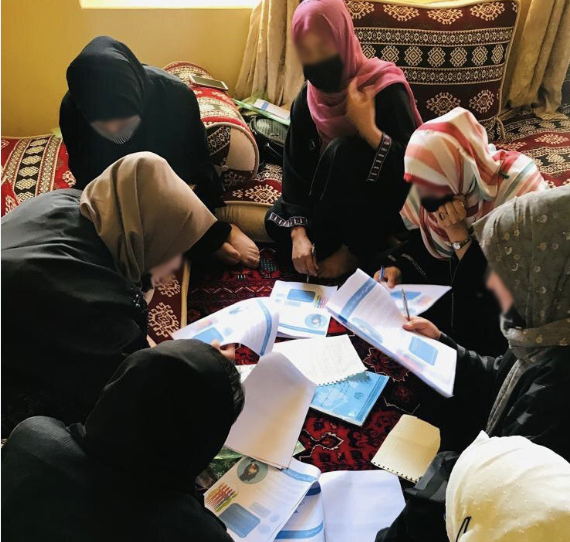
Access to education during the pandemic is one such concern, especially for those with limited internet connectivity and living with traditional gender norms, remains a challenge in many countries. For example, in Iraq many family members do not allow girls to use the phone or internet for more than an hour per day. Even at the university level, technology use is limited. One woman peacebuilder convened the first zoom call for over 100 university students, men and women, to discuss fundamentalism. Yet in Afghanistan, it is a men’s network which has supported women during the COVID-19 crisis that, according to Afghan officials, could infect 80% of the population if urgent action is not taken. The men’s network encourages families to send their girls to school, which also mitigates early marriage. While access to the internet is limited especially in rural areas, a woman peacebuilder has hired project coordinators to teach five girls at a time, maintaining physical distancing protocols. In Pakistan, the international community has not directly funded educational institutions and as the COVID pandemic carries on, communities are losing key time to educate children and youth. In addition, the pivot to online learning creates a challenge in contexts besought by violent extremist groups who have co-opted the internet to spread their propaganda and recruit new members. Women peacebuilders navigate this tension to instill awareness among youth to continue their education while avoiding extremist narratives.
If ever there was a time to redefine security, collect the right data, listen to local organizations and to fundamentally re-think how we actually circulate money around the world, this is the time for it
Ambassador Jacqueline O’Neill, Canadian Ambassador on Women, Peace, and Security, having listened to the challenges facing women peacebuilders, observed, “a crisis doesn’t change who you are. It reveals who you are.” She committed to identifying how the whole system can change so that government commitments and development aid can reach local communities and provide the basic services of food, healthcare, and education. “If ever there was a time to redefine security, collect the right data, listen to local organizations and to fundamentally re-think how we actually circulate money around the world, this is the time for it.”
Click here to download the call summary in PDF format
Summaries of the rest of the calls can be accessed here
The WASL calls are held weekly on Thursdays at 9am EDT.
For more information please contact Melinda Holmes, WASL Program Director
melinda.holmes@icanpeacework.org.