ICAN’s Holistic Security Menu: A New Way to Support Women Peacebuilders
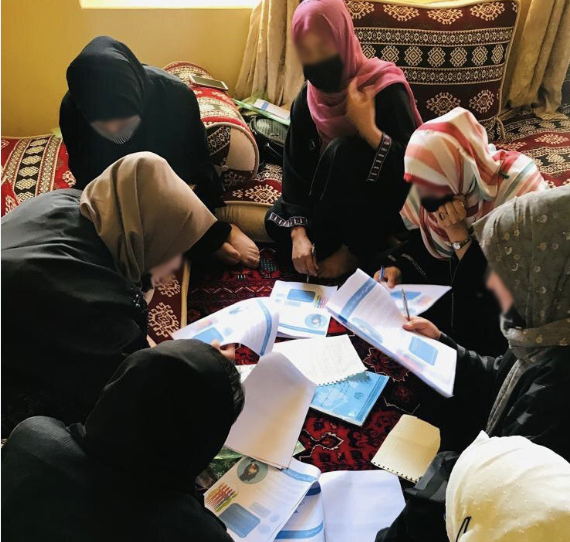
Women peacebuilders often operate in some of the world’s most dangerous contexts—yet the security support available to them is frequently fragmented, repetitive, and short-term. Recognizing the need for a fundamentally different approach, ICAN conducted a holistic security assessment of its Afghan partners, including members of the Women’s Alliance for Security Leadership (WASL). The result is the Holistic Security Menu: a co-designed, partner-driven model that provides practical and sustainable security support—on women peacebuilders’ […]
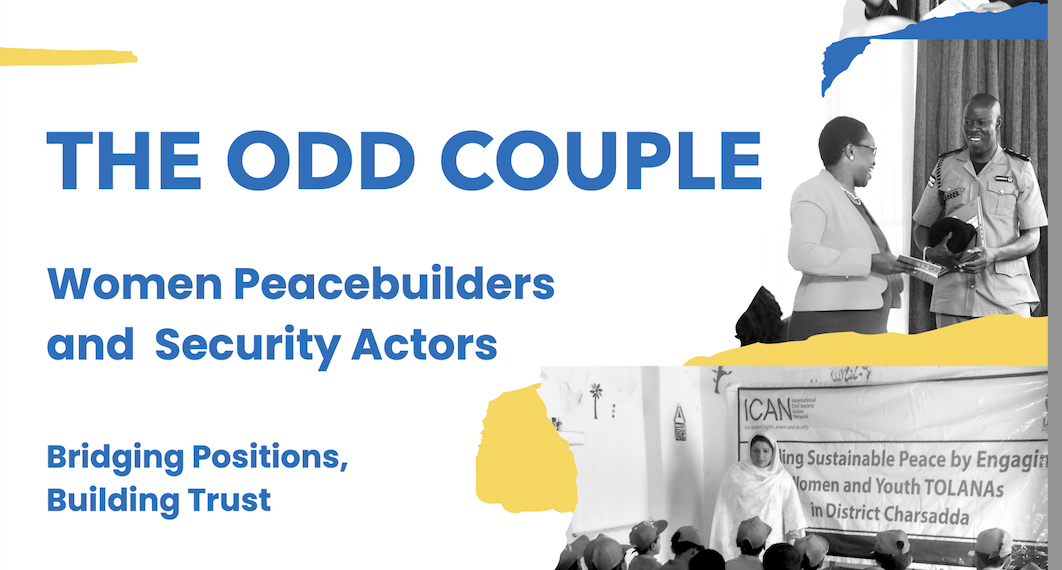
The Odd Couple: Women Peacebuilders and Security Actors Bridging Positions, Building Trust
The WPS agenda has proven a vital entry point for women peacebuilders to engage with the security sector and build trust within affected communities. These efforts—often invisible—are contributing to the reform of the sector, reshaping local security environments and mitigating violence.
The War Against Ourselves: Afghan Women Peacebuilders’ Response to the Mental Health Crisis in Afghanistan
This case study describes the drivers of the mental health crisis in Afghanistan, its gendered and cultural dimensions, and the strategies used by Afghan women-led peacebuilding organizations to provide solutions. The authors conducted interviews with representatives of Afghan women-led peacebuilding organizations and thematic experts, which were complemented by a desk review of project documentation and […]
Open Statement to the United Nations Security Council on behalf of Women Peacebuilders Marking 25 Years of the Women, Peace, and Security Agenda
On October 6, 2025, the U.N. Security Council holds its annual open debate on Resolution 1325 on Women, Peace, and Security. Today, we are not issuing a new statement. Instead, we are honoring our community of women peacebuilders—who appeared before the Security Council throughout these 25 years, speaking for the millions they represent—by echoing their messages.
Home»Stories»
Sisters of Peace in Iraq: Diffusing the Timebomb of a Divided Mosul
Sisters of Peace in Iraq: Diffusing the Timebomb of a Divided Mosul
24 July 2023
By Lauren Mellows
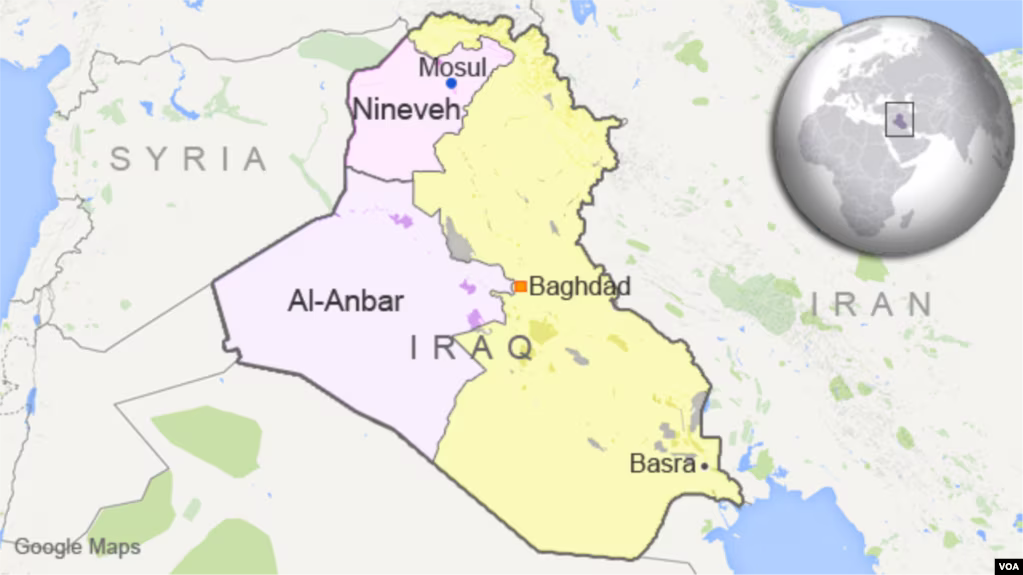
In the war-torn city of Mosul, Iraq, the scars of conflict run deep. The rise and fall of the Islamic State of Iraq and Syria (ISIS) left behind a community fractured by violence. ISIS male fighters were killed, captured or fled, but the women they married, and their children remained. Referred to as “ISIS-associated families”, they are stuck in limbo, without legal status and facing ostracism and isolation.
The challenge of reintegrating these families into society is a daunting task, but the Odessa Organization for Women’s Development (Odessa) – a partner of the International Civil Society Action Network (ICAN) and member of the global Women’s Alliance for Security Leadership (WASL) – is making significant strides in bridging this divide.
Torn Communities: Women’s Contrasting Realities in Mosul
Maysoon Ahmed Ismael founded Odessa in the Nineveh Governorate in northern Iraq in 2009. In the wake of the US occupation and withdrawal, the situation of women had deteriorated significantly, so her goal was to protect and defend women’s rights and ensure their social, political, and psychological empowerment.
Mosul, the capital city of Nineveh Governorate, became a significant stronghold for ISIS during its rise to power. For several years from June 2014, the group imposed a reign of terror in the city, carrying out brutal acts of violence, enforcing strict Islamic law, and conducting mass executions. The foreign wives of ISIS fighters also traveled to the city. Some women actively participated in supporting ISIS’s agenda, while many others were coerced or influenced to follow the group’s extremist ideology.
In 2017, a joint effort involving the US, Iraqi, and Iranian forces routed out ISIS, killing many of the fighters or forcing them to flee. The fate of the remaining ISIS wives varied. Some were detained or repatriated, while many others and their children were sent to displacement camps run by the Iraqi government. During this time, Odessa began providing pro bono legal support and services to ISIS-associated families exiled to camps outside of the city. However, the camps were not meant to be a permanent solution, and in October 2020, Iraq’s Migration and Displacement Ministry announced their sudden closure.
ISIS-associated families began to return to areas of the city, but as the authorities had no rehabilitation and reintegration plans for them, Maysoon Ahmed Ismael and her team at Odessa foresaw major problems. Many Mosul residents devastated by ISIS crimes reject the families’ return to their communities. As a result, these women were subjected to revenge violence, societal rejection, and discrimination.
Since their marriages were not officially registered, the women and their children often lacked legal status, and many continue to struggle to obtain official documents and identification. In the meantime, they are excluded from receiving essential services such as healthcare and schooling for their children. Currently, these women and their families reside in abandoned, underserved, unsafe areas of the city, making them vulnerable to criminal activities, abuse, and exploitation. The persistent rejection and limited access to justice and resources may breed resentment and radicalization in the next generation of children, risking a perpetual cycle of violence and extremism.
“In these circumstances the children may become a copy of their fathers. This community has lost all trust and is totally isolated… we don’t want them to become like a bomb that is waiting to explode – this will affect our local and national security.”
– Maysoon Ahmed Ismael
Odessa Sisters of Peace Project
Breaking Barriers: Bringing the Women Together
Through consultations and exchanges with the ICAN team and funding from ICAN’s Innovative Peace Fund (IPF), in 2021 Odessa designed the “Sisters of Peace” project to address these challenges. A whole–of–society approach is needed, and working with mothers is one avenue, Maysoon Ahmed Ismael explains:
“We believe that if we make an impact on the mother, she will make an impact on her children, and we will not have these kinds of security threats in Mosul.”
This is complemented by working with the community more broadly. Recognizing the significance of social acceptance, the goal was to help Mosul community members understand what had happened to these individuals and foster social cohesion.
The “Sisters of Peace” project targeted 40 women: 20 women from the Mosul community and 20 women associated with ISIS. Initially, there was resistance from the latter group, who were cautious about engaging in the project, but with time Odessa was able to build trust and encourage their participation.
“There is a feeling of fear [among ISIS-associated women] and little interaction with anyone – even those who are trying to give them help.”
– Maysoon Ahmed Ismael
Recognizing the mistrust on both sides, Odessa’s approach was to start by working separately with the two groups to build awareness of women’s roles in building peace, focusing on empowerment, education, and psychosocial support. Gradually, they brought the women together for group workshops and training on running small businesses. Through dialogue, they found that as women, they had more commonalities than differences – especially in terms of their concerns about livelihoods and the safety of their children.
Sisters of Peace
ISIS Families: Unveiling Stories of Change and Transformation
Within the group of ISIS-associated women, changes in behavior were observed almost immediately. With each training session, Odessa saw visible shifts. They began with small, often personal, but symbolic actions. For example, as trust built, many chose to remove the niqab, wear more color, use a little makeup and perfume, and take greater pride and care in their physical appearance. Though seemingly insignificant, these were radical steps for many, given the strict adherence to black hijab and total cover that ISIS and other extremists demand. The women’s willingness to step outside the rules imposed on them hinted at a newfound freedom. As they opened up, they expressed their own thoughts and embraced life beyond their former roles as ISIS wives.
Most importantly, the project had significant impacts on the participants’ mindsets, fostering positive behavioral changes, confidence, and increased openness to opportunities and relationships. Women associated with ISIS, who initially adhered strictly to their deceased husbands’ beliefs and saw it as their duty to instill the same in their children, started questioning these ideologies. Ultimately, Odessa successfully enabled the women to regain their self-esteem, develop livelihood skills, and start rebuilding their lives.
Mosul Women: Redefining Perceptions and Fostering Acceptance
The women from the Mosul community also displayed changes. During the first meeting, they met the women associated with ISIS with skepticism and refused to even talk to them. However, as they began to understand these families’ challenges and recognize their commonalities as mothers, Odessa witnessed increased acceptance, empathy, and communication. Maysoon Ahmed Ismael explains:
“They [Mosul women] began to have acceptance, after that they began to have empathy, after empathy came communication, and creating relationships.”
Relationships began to form across the two groups, bridging the divide between ISIS-associated families and the Mosul community. For example, the women started exchanging invitations to social events and celebrations, and a Mosul mother proposed her son’s hand in marriage to another group member. Odessa also witnessed information exchanges and economic support among the women and improved relationships among their children.
Sisters of Peace Workshop
Advocacy and Collaboration: Influencing Government for Sustainable Reintegration
Building upon the success of the “Sisters of Peace” project, Odessa developed a second phase to engage local government and authorities in addressing the barriers to social cohesion and reintegration. Seven women representing both groups from the first project were selected for this phase because of their recognizable behavioral changes, literacy level, and belief in the project.
With technical support from ICAN, Odessa trained the women to conduct needs assessments, collect data, advocate for change, and engage in conflict resolution. Together, this group was the “peace committee”.
The committee regularly visits communities in Mosul to gather information about the needs and challenges confronted by ISIS-associated families. They carefully analyze the collected data and prepare reports, which are then submitted to Odessa. Odessa arranges monthly meetings between the committee and government representatives to facilitate effective communication and advocate for necessary changes.
Peace Committee and Government Consultation
Aside from being recognized and respected as peace ambassadors by the community, the committee is used as a reference for resolving conflicts. They have already proved effective in resolving a marital conflict and settling a dispute between a group of young people.
Odessa and the peace committee have also seen the result of their efforts at a governmental level. A major success has been their advocacy to the Ministry of Education to allow schooling for children without identification for the first cycle of education (up to Grade 6). Odessa sees this as just the first step and is eager for greater political will, support, and action on behalf of the government.
A Model Approach: Paving the Path to Lasting Peace
Despite facing numerous challenges, including attacks on the organization and her own reputation, Maysoon Ahmed Ismael remains determined to carry out this work.
In addition to funding, ICAN has supported Odessa with institutional capacity building, strategic accompaniment, and training on monitoring and evaluation. As the success of Odessa’s projects becomes increasingly apparent, there is an opportunity for it to serve as a model for similar initiatives across Iraq and in other contexts.
“When other donors see that we face challenges, they immediately cancel the project. The Innovative Peace Fund allows for flexibility. They gave us a safe space to discuss challenges and have transparency in running the project.”
– Maysoon Ahmed Ismael
Maysoon Ahmed Ismael is inspired by the success of Odessa’s projects and emphasizes how, in just six months, they were able to create real and lasting harmony between women from Mosul and women associated with ISIS. She advocates for other organizations and government entities to replicate their transformative approach in communities suffering from conflict and social fragmentation.
By recognizing the humanity and victimhood of women associated with ISIS and creating an opportunity to engage with the Mosul community members, Odessa has fostered healing, understanding, and reconciliation. Through their tireless efforts, Odessa has facilitated and equipped the two groups of women to mend fences and become agents of change, spreading peace within their communities and pushing the Iraqi government to take action.
“They are really acting as ambassadors of peace; they are spreading peace in their local areas and the community is recognizing them as that.”
– Maysoon Ahmed Ismael
Timeline: The Rise and Fall of ISIS in Mosul
Mosul, Nineveh Governate, Iraq
June 2014: ISIS captures Mosul. Iraqi security forces collapse, and ISIS establishes control over the city.
June 2014-15: ISIS imposes strict Islamic law, implementing a reign of terror in Mosul.
October 2016: Iraq launches a U.S.-backed offensive to retake Mosul.
July 2017: Mosul is liberated from ISIS control. ISIS-associated families are sent to government run displacement camps.
October 2020-Present: Iraq’s Migration and Displacement Ministry announces the sudden closure of displacement camps. Displaced individuals are forced to relocate or return to Mosul.
On October 6, 2025, the U.N. Security Council holds its annual open debate on Resolution 1325 on Women, Peace, and Security. Today, we are not issuing a new statement. Instead, we are honoring our community of women peacebuilders—who appeared before the Security Council throughout these 25 years, speaking for the millions they represent—by echoing their messages.
ICAN FeaturedICAN LatestICAN UpdatesWASL UpdatesWomen's Alliance for Security Leadership
On behalf of the International Civil Society Action Network (ICAN) and members of the global Women’s Alliance for Security Leadership (WASL), we are honored to nominate Francesca Albanese, United Nations Special Rapporteur on the situation of human rights in the Palestinian territories occupied since 1967, for the 2026 Nobel Peace Prize.
در عرصه صحت روانی، افغانستان با بحران پیچیدهای مواجه است که این بحران به طور جدایی ناپذیر با ناامنی شدید فیزیکی، سیاسی و اقتصادی در کشور گره خورده و این نا امنی ها بحران را تشدید میکند. برای رسیدگی به آسیب های روانی، صحت و بهداشت جامعه به شیوه های پاسخگو به جنسیت و با مد نظر گرفتن حساسیت های فرهنگی، سازمانهای فعال در عرصه صلح سازی به رهبری زنان افغان در موقعیتی منحصربه فرد قرار دارند. این سازمان ها خدمات ابتدایی ارائه میدهند، مهارتها را توسعه میبخشند و در شکلدهی هنجارهای فرهنگی و جنسیتی نقش مؤثر ایفا میکنند.
ICAN FeaturedICAN LatestICAN UpdatesWASL UpdatesWomen's Alliance for Security LeadershipWPSO
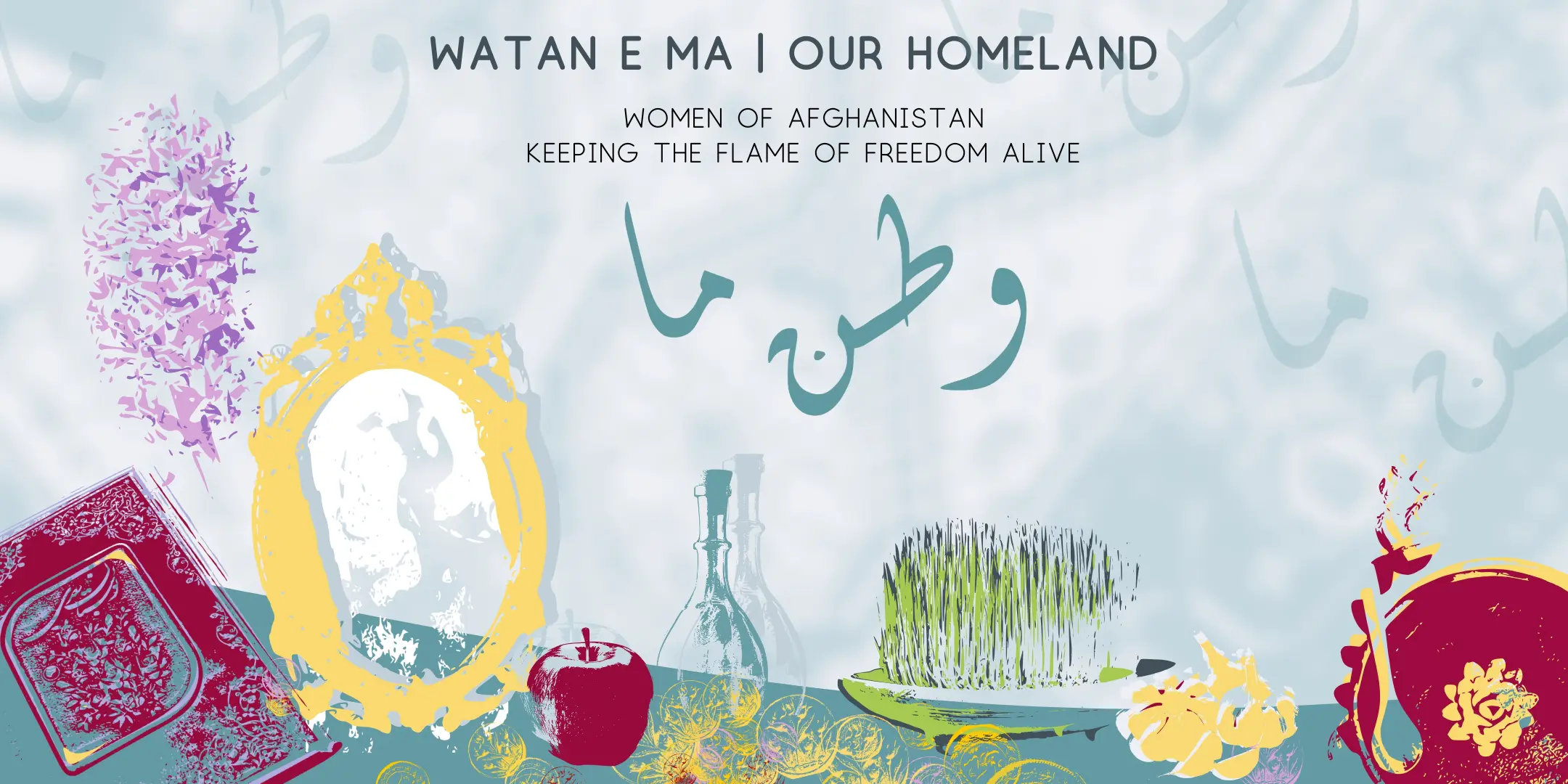
In a powerful departure from traditional advocacy, ICAN—guided by our Afghan partners and women peacebuilders—hosted the event “Watan e Ma – وطن ما – Our Homeland: Women of Afghanistan Keeping the Flame of Freedom Alive” on March 17, 2025 at Blue Gallery in New York City. Held during the 69th Commission on the Status of Women (CSW69), the event celebrated Afghan cultural heritage and the resilience of Afghan women peacebuilders, who persist in their leadership for peace, justice, and equality under the Taliban’s regime of gender apartheid.
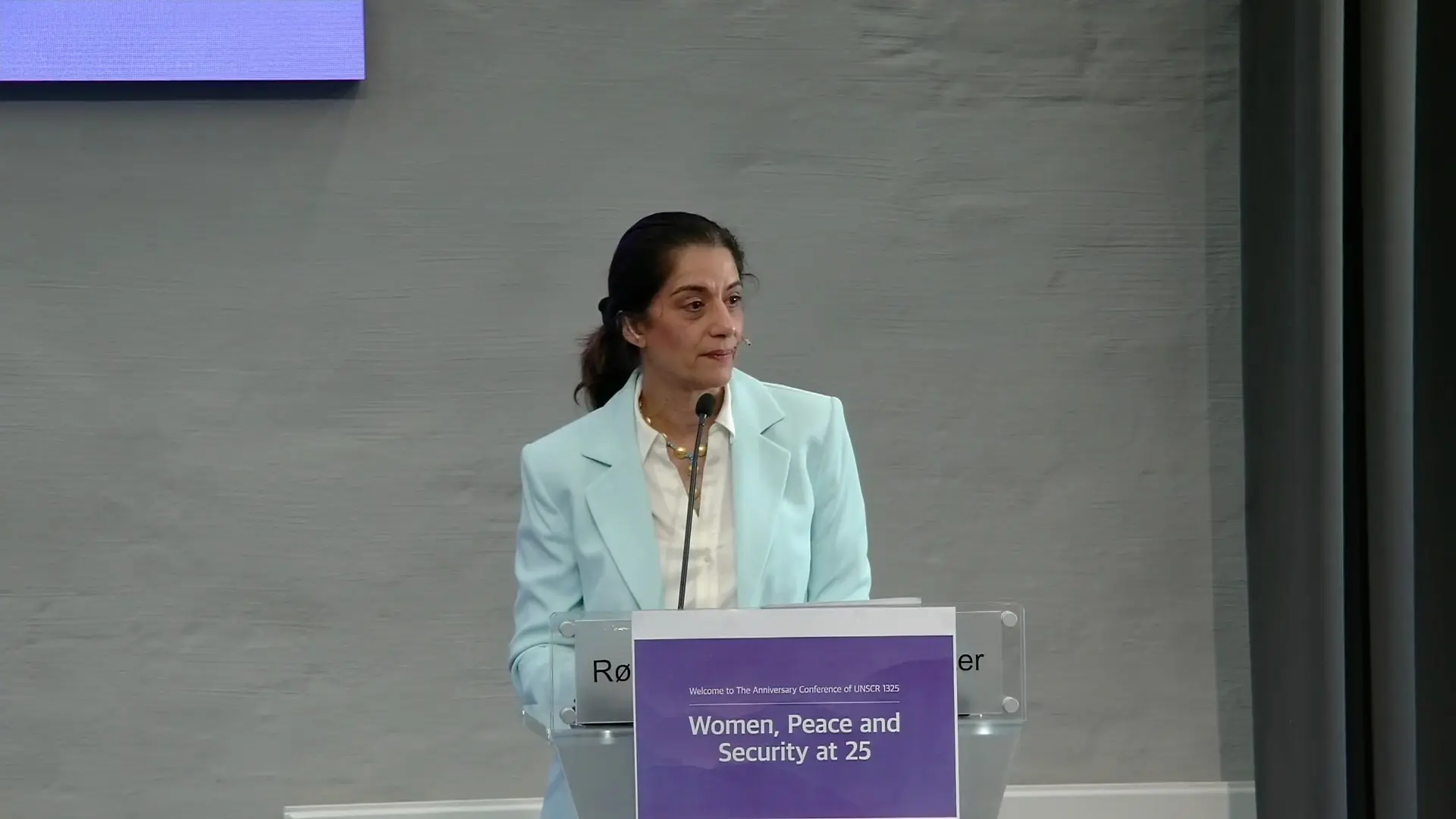
On May 5, 2025, ICAN's Sanam Naraghi Anderlini delivered the keynote speech at the two-day international conference "25th Anniversary Conference of UNSCR 1325 Women, Peace and Security."
As Senator Mobina Jaffer concludes 23 years of distinguished public service in the Canadian Senate, we extend our deepest thanks for her steadfast leadership as Chair of ICAN’s Board of Directors from 2014 to 2024.
Together with André Mundal, our new Interim Chair of the ICAN Board of Directors, we are delighted to welcome two new members to our Board of Directors.
Trust between communities and the security sector is critical for effective governance and peace. So is a vibrant civil society. When women peacebuilders are recognized and engaged as independent, strategic partners and security actors—in their own right—the results are transformative. Twenty-five years on from the launch of the WPS agenda, women peacebuilders’ creativity and contributions to societal peace and security are not only timely, they are even more essential.
Allamin FoundationAWAPSAAWAWBetter Peace InitiativeCIASECoACTGEN MyanmarGender and ExtremismsICAN FeaturedICAN LatestICAN UpdatesPAIMANPCIDWASL UpdatesWomen's Alliance for Security Leadership
Afghanistan is facing a complex mental health crisis inextricably linked with and compounding the dire state of physical, political, and economic insecurity in the country. Afghan women-led peacebuilding organizations are uniquely positioned to address community members’ health and wellness in gender-responsive, culturally- sensitive, and trauma-informed ways.
ICAN FeaturedICAN LatestICAN UpdatesWASL UpdatesWomen's Alliance for Security LeadershipWPSO
As the Women’s Alliance for Security Leadership (WASL) continues to expand globally, fostering stronger regional and national networks, we are excited to announce the formation of the first-ever WASL Steering Committee.