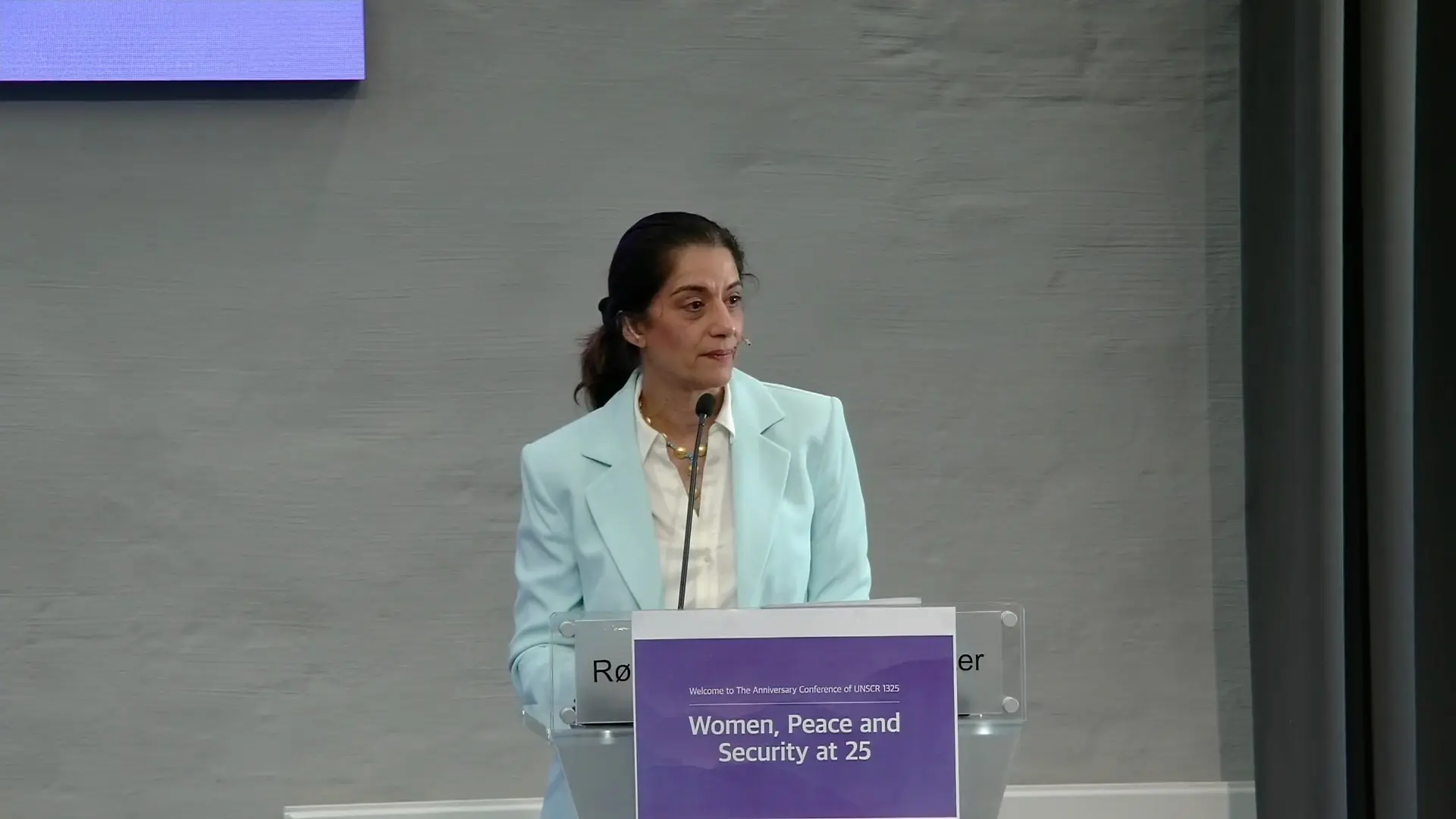
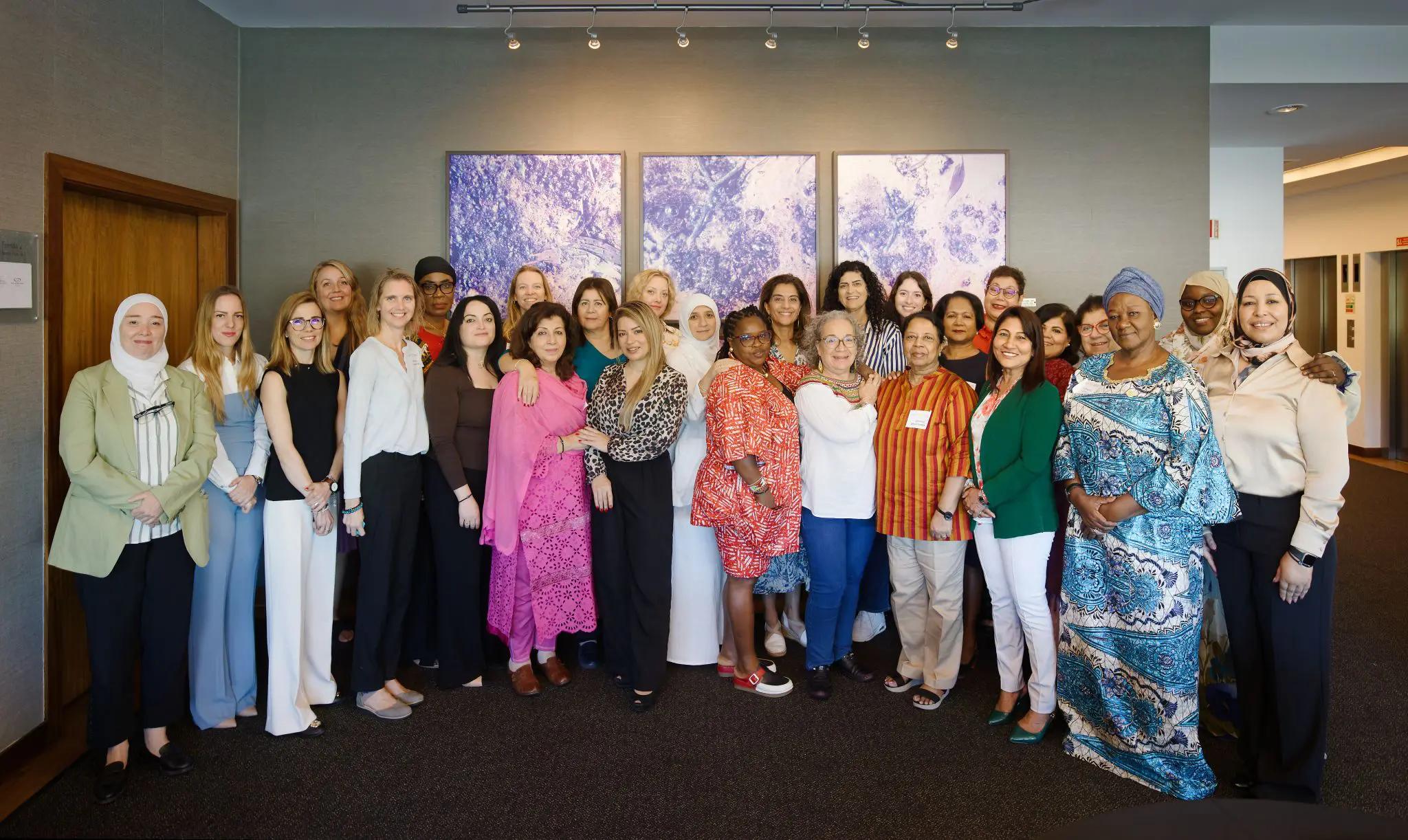
On May 5, 2025, ICAN’s Sanam Naraghi Anderlini delivered the keynote speech at the two-day international conference “25th Anniversary Conference of UNSCR 1325 Women, Peace and Security.” The conference was organized by the Norwegian civil society organizations in the network Forum 1325 and Norwegian research institutions.
Read the full transcript below.
Thank you, everyone. Me, an ICON? That’s a sign of getting old as well.
This is a very auspicious year for those of us who believe in peace, human security, pluralism, and all these things that are at risk right now.
I want to thank you for, in a way, inaugurating the year for those of us who care about these issues, and talk to you about where we were, where we are, and where we need to go.
It’s hard because I am filled with rage, to be honest with you. I’m filled with the rage of the lost opportunities, and of the lost lives, and of the futures that we forsake and forsook because of political expediency.
I think about the girls in Afghanistan who are walled in their homes because our diplomats refused to listen to the voices and the warnings of Afghan women and those of us who advocate for engagement with Afghan peacebuilders in Doha. Afghanistan wasn’t lost in the battlefield. It was given away in Doha. And we who live in the West, who pay our taxes, are culpable for the future of those girls.
I’m filled with rage at what is happening in Gaza today, and in the West Bank, and the bombings that go on in Syria, and the sheer impunity and the attacks on the International Criminal Court and all of the rules and laws that generations before us created for us to live in peace.
We are holding that legacy and our political leaders––who won’t be around, because so many of them are, frankly, very old––lived and benefited from that legacy, and they’ve just frittered it away. They are destroying the world for the generations to come. It’s a deep level of selfishness, which genuinely fills me with rage.
At the same time, I’m feeling defiant because we’re not going to let these guys win. I don’t believe that we’re in the era of strongman politics. We are in the era of weak men politics, because it’s a weak man who cannot sit face to face or on the same side of the table to look into the future.
But imagine. Imagine if the cohorts of extremist leaders that we have out there had the guts to do what women peacebuilders do every day. To go and speak to the adversary, to see the humanity in the other, instead of sending young men––and increasingly young women––to drop bombs and drones and get killed and traumatized.
Instead, they’re sitting behind a desk. They’re sending the next generation to be maimed and traumatized, and that’s a sign of weakness. We can’t let those guys win.
Frankly, I’m filled with despair because what I feel is that we have seen this playbook before.
As [Foreign Minister Espen Barthe Eide] said before, it was the 1920s and the 1930s. I would go back to the early 1900s when Bertha von Suttner, who was the inspiration behind the Nobel Peace Prize, warned the world about the risks of militarization.
It’s the same sentiment right now. The U.S. has just declared that in 2027, their military budget is going to be $1 trillion. The European Union has said it’s going to be $800 billion. And we all know these ramp-ups in defense spending and in weapons spending means cutbacks in human security spending at home and abroad. It means cutbacks in funding for peacebuilding, and for development, and for all the underlying factors that actually keep societies together. And where does that take us?
About all this expenditure on weaponry: I sometimes say they’re only useful if they remain entirely useless and unused, because the minute we start using them, what kind of security do we have anyway? We’re all going to be mutually obliterated.
Our political leaders are literally beating the drums of war at this higher level, while at the local level on the ground, it’s women, often women peacebuilders, [bearing the consequences].
At ICAN, we spearhead the Women’s Alliance for Security Leadership. It’s a network of independent women-led peacebuilding organizations in 42 countries.
The image I have is that as things come from above, they’re reaching out and have to have multiple arms to take on these responsibilities. Because the responsibility to protect, the agenda of the Responsibility to Protect, sits squarely on the shoulders of women at the front lines of war zones around the world.
They are taking the responsibility to protect while the powerful, those who have the power to prevent, are abrogating that responsibility. There’s no accountability. Our politicians, our diplomats, our humanitarian agencies…where’s the accountability?
If you’re involved in setting the stage for the Syria reconciliation process, or the transition process, or statehood for Palestine and Israel, or whichever of these conflicts, where is the accountability for our senior diplomats in terms of their responsibility to ensure that the local peacebuilders are present and heard and heeded? It’s not happening.
We get the speeches. We get lovely commitments on paper. We’ve got endless National Action Plans. But the reality is nothing is happening because this work remains siloed. It remains the responsibility of individuals and ministries, individual departments.
It’s about panels and discussions, and it’s important to have these panels and discussions. But what else are we meant to say after 25 years?
We have the evidence. We have the practice. We’ve created the ecosystems. When they said, “We don’t know how to fund,” we created funds and now we fund on the ground.
When they say, “We don’t have the appetite for risk,” my partners turn around and ask, “Who’s taking the risk?”
The women who are negotiating with Boko Haram and the Taliban and Al-Shabaab, and dealing with their own security actors knowing that they could be put at risk, are they taking a risk? Or is it our faceless ministries and bureaucracies that are nickel and diming our organizations around the world?
These are the realities of our lives in the last 25 years, and what I struggle with is that this agenda was meant to be transformative. It was innovative. It was radical.
It was about radical, innovative, imaginative diplomacy—about sitting at the table and recognizing peace actors, not just warring actors, not just the guys with the guns or the women with the guns, but the women who dare to come forward and try and find solutions.
We in the West who claim to support diplomacy should be heeding those voices. It’s not about localization. The locals exist.
Those women peacebuilders were there before we showed up. They’re going to be there after we disappear. They have been there through time and history and geography. In all the research I’ve done, in all the research that is now evident, women emerge and deal with crises when the crises emerge. So, they’re going to be there. The question is, are we on their side or are we against them?
And this is really where the buck stops. At the moment, with the cutbacks in funding, with the backlashes that are happening, we have to decide whether we lean into the forces of backlash and start to say, “Oh, yes, well, you know, we don’t have the money. We can’t support peacebuilding on the ground. You know, we have to do just the humanitarian work.” Do we accept, without questioning, the repeated trope that, “Oh, it’s our culture. That’s why women are excluded.”
It’s never about culture. It’s always about power. The men don’t want us there. The war actors don’t want peace actors there because peace actors hold them accountable. I’ve been in the mediation spaces and those “Wizard of Oz” spaces that are so exclusive. And we think, “Oh gosh, these mediators really know what they’re doing.” I’ve been there and trust me, it is about power, it is about corruption, it is about money, it is about the lack of accountability.
Because women peace actors, women who defend human rights, women who are doing the humanitarian work on the ground, when they have the opportunity to come across a warlord or a government minister or whoever it is in their country that is killing their own civilians, the first thing they do is they point the finger and ask, “What are you doing? Why are you killing our children?”
It’s not an argument about culture. It’s about power and not wanting the women present—not just any women, by the way—the women who have the courage to become actors of peace.
It’s very different to generic women because every once in a while, we see a woman, a token here and token there [in mediation spaces]. It’s not about that. It’s about those who’ve had the courage to engage with peace.
So, these are the choices. Do we side with and enable these forces of backlash?
Do we, do our governments, enable the erasure of this work? Or do we stand up for humanity and pluralism? Do we cut back the bureaucracy to just get the work done?
We don’t need more reports. We need to say today, in Syria, Ethiopia, Colombia, the Middle East, where are our diplomats who are engaging in these processes? Are they talking with the women peacebuilders on the ground?
As of today, as of tomorrow, Monday morning…is it happening?
It’s also about fostering an ecosystem. Because what I really worry about is that as this conversation about UN reform goes on…How many of you in this room, in your organizations…how many of you have been consulted about UN reform?
[No hands in the audience were raised]
We pay the taxes as citizens. We are paying the taxes for our bureaucrats and our civil servants internationally and nationally, right? So, on that level, they’re accountable to us.
On the level of 10 Security Council Resolutions on Women, Peace, and Security—they are accountable to all of us. On the level of the fact that we collectively, as organizations and our partners around the world, are taking on the risk and the hard work of doing peace and mediation work on the ground— they are accountable to us in terms of the reform.
And frankly, very simply, we have answers. We actually get the work done. We know what the practical solutions are. What on earth are they doing ignoring this vast volume and body of experience sitting in civil society?
At the end of the day, what we need is an ecosystem model where we say, if the locals have the access and the trust, let’s listen to them. How do we as an international organization enable and support them? What’s my role as an international organization?
How do I then hold the hand of my government, whether it’s the UK, Canada, or Norway and say, “Please, we need you to do XY and Z and what does the UN do?”
Comparative advantages. Each of us has a comparative advantage. Each of us has certain power and each of us has certain limitations. We need to combine that, not replicate, not duplicate, not ignore what’s out there.
But this UN reform process doesn’t seem to me to be engaging with this. We’re just going to end up being words on paper again.
Business as usual is a real threat and it’s no longer just a threat to those of us in our community of practice. It’s a threat to our societies because this extremism and these forces are now lapping up very close to our doors. So, what do we do?
I was thinking about this in terms of imagining what a little girl in Gaza or a little girl in Afghanistan or a pregnant mom in Sudan might be writing to us in 10 years’ time or 15 years’ time.
Time goes by really fast. What would success look like? What actions could we as civil society, as governments, as the UN, take today so that in 10 years or in 15 years’ time, that little girl is writing to us and saying, “Thank you, because you made sure that the humanitarian assistance that came was gender sensitive. Because you made sure that all these agencies that are working with displaced populations actually integrated prevention of sexual violence strategies in the field, in the work that they’re doing, in the services they provide. Rape did reduce. Rape was no longer normalized in these settings.”
What about the girls in Afghanistan? What will they be saying to us? Are they going to be like the women in Iran, where it’s taken 45 years and three generations to burst the dam of an extremist Islamist regime? Or are we going to enable them to do it over one generation? And Israel? Palestine?
When we started this work on 1325 back in the 1990s, I was inspired by the work of Israeli and Palestinian women who were talking with each other across the divide. They came up with many of the solutions that today we say are the Oslo process or the peace plan. It was Israeli and Palestinian women who negotiated amongst themselves and came up with those solutions and put it out into the public sphere. They’ve been erased from history.
But today, we have a new generation of Israeli and Palestinian women. We have organizations like Women of the Sun in Palestine and Women Wage Peace in Israel, and so many others that are taking the risks of working together. Imagine if we listen to them. Imagine if we let them be our advisors for what should be done to address the crisis there.
I don’t think that we’re going to get a solution if we bring the same diplomats, and the same political leaders, back at the same tables, and try and forge something. It’s the definition of madness. It’s what got us to where we are now.
What we need are actually people’s peace processes. We need two parallel national dialogues where Palestinian journalists and doctors and mothers and young people—all the people that have suffered from this violence, who’ve suffered from the policies that Hamas instigated—can sit with Hamas and with the Palestinian Authority and their political leaders. And they, the people, should be determining what they want going forward.
Similarly, in Israel, let civil society, the journalists, the civil human rights organizations, and the families of the hostages sit on equal footing with their politicians to decide the future.
I can guarantee you it would be a very different picture. Because what we see repeatedly is that as women, when we sit and engage, we understand the trauma of the past. Of course we do.
But one of the very critical things that we see repeatedly that women peacebuilders bring into peace processes is the ability to look to the future. The ability to say, “What’s the future I don’t want?” and “What’s the future I want for my children, for all of our children?”
Let that image guide the actions of the present to enable us to deal with the past. Politicians, militants, and others are stuck in the past. They’re letting the past shape the present and then shape the future.
This flipping is how we should be thinking about the determination of peacemaking. This future approach is what women bring to the table very often. Yet we’re not listening to them.
So, I think that it’s time to stop planning, stop more recommendations, and just get on with it—embed it in the work that our governments and ministries are doing.
I will end with this. Those of us in civil society are so tired, are literally, physically, emotionally exhausted that we could be losing an entire generation going forward. This is a danger; this erasure of this experience is a danger for the future generations to come. So, I also think that it’s time for us to be documenting the stories of the individuals.
This agenda is not some bureaucratic thing. It was the work of people who really, really cared. There were human beings behind it and there are human beings right now pushing the rock up the hill. We need the visibility of human stories.
My generation benefited from the world opening, wanted to engage in geopolitics, and wanted to bring the words of the UN Charter to life. The UN Charter starts with “We the peoples of the United Nations,” and it talks about wanting to prevent the scourge of war. That’s what my generation came into adulthood with, and that’s what we fought for.
It’s time that—as we pass the baton to the next generation—the stories of the past are also shared. Because if we erase it, then we’re taking everybody back 25 years.
Thank you very much for this chance and I hope that we get to talk as well.
Thank you.