The Odd Couple: Women Peacebuilders and Security Actors Bridging Positions, Building Trust
The WPS agenda has proven a vital entry point for women peacebuilders to engage with the security sector and build trust within affected communities. These efforts—often invisible—are contributing to the reform of the sector, reshaping local security environments and mitigating violence.
The War Against Ourselves: Afghan Women Peacebuilders’ Response to the Mental Health Crisis in Afghanistan
This case study describes the drivers of the mental health crisis in Afghanistan, its gendered and cultural dimensions, and the strategies used by Afghan women-led peacebuilding organizations to provide solutions. The authors conducted interviews with representatives of Afghan women-led peacebuilding organizations and thematic experts, which were complemented by a desk review of project documentation and […]
“This doesn’t concern women.” Military and security issues are ‘technical’ and ‘not relevant’ to women peacebuilders.
Some argue that women do not need to be included in peace negotiations because the military and security issues on the table are not relevant to their concerns. Women are underrepresented in security and military roles, and may be perceived as lacking credibility without this experience. Conversely, there is a perception that so-called “women’s issues” are not relevant to the security-focused agenda.
But this dismissal overlooks the key role that these issues play in conflict dynamics—from sexual violence to the security needs of civilians during ceasefires. When they are included in peace talks, women consistently broaden the set of issues to be discussed, raising a variety of short-term and long-term security and development issues. This agenda ultimately helps push the process toward a more comprehensive agreement and a more lasting peace.
How to overcome this barrier:
1. Point out that the majority of topics women raise are security related, including knowledge of land-mined areas, threats, and security needs of civilians that armed actors may not raise.
2. Highlight women’s keen understanding of changing patterns of violence and their monitoring of risks; they are often more mobile in conflict settings and have valuable local knowledge to share.
3. Note that women are well connected to their communities and can serve as excellent members for ceasefire/monitoring teams as in the Philippines.
4. Remember that women peacebuilders tend to be trusted in their communities; they can support perception surveys and collect valuable information on civilian opinions of security threats, ceasefires, and other matters.
5. Be aware that conflict-related sexual violence is often a key factor exacerbating conflict and making ceasefire agreements fragile; if addressed during peace talks or included in ceasefire agreements, it can build confidence in wider process, and limit harm if talks fail.
In October 2010, the Mindanao Peoples Caucus launched its all-women contingent of the Civilian Protection Component deployed to monitor ceasefire agreements. The initial 30 women came from diverse ethnic and religious backgrounds from across the Philippines. Many had lobbied hard for greater attention to women’s war experiences and adherence to UNSCR 1325. Aged between 20 and 62, they were deployed throughout the conflict affected areas of Mindanao with a clear mandate to monitor the safety of civilian communities, ensure that conflict parties respected the sanctity of places of worship, monitor the delivery of aid to local populations and IDPs, and deepen local ownership and buy-in for the peace process. While some military and religious leaders were initially skeptical of the women, community responses were positive. By virtue of their diversity, they bridge the divide between different warring communities, and because members of the group lived through war, they have deep compassion for and commitment to civilians and the willingness to negage the military and rebels constructively.
ICAN’s Mission Five Steps for Sustainable Prevention of Sexual Violence in Conflict ICAN Partner AWAPSA: A Catalyst for Kenya’s First SGBV Court The War Against Ourselves: Afghan Women Peacebuilders’ Response to the Mental Health Crisis in Afghanistan Protecting Women Peacebuilders: The Front Lines of Sustainable Peace
Thank you for your donation to ICAN. Your contribution strengthens women peacebuilders who are preventing violence, protecting communities, and rebuilding trust in some of the world’s most fragile contexts. By supporting ICAN and the Women’s Alliance for Security Leadership (WASL), you help women-led organizations in more than 40 countries mediate conflicts, assist families in crisis, and drive […]
On behalf of the International Civil Society Action Network (ICAN) and members of the global Women’s Alliance for Security Leadership (WASL), we are honored to nominate Francesca Albanese, United Nations Special Rapporteur on the situation of human rights in the Palestinian territories occupied since 1967, for the 2026 Nobel Peace Prize.
We are deeply honored and excited to welcome Terry Greenblatt and Sawsan Chebli to the International Civil Society Action Network (ICAN) Board of Directors.
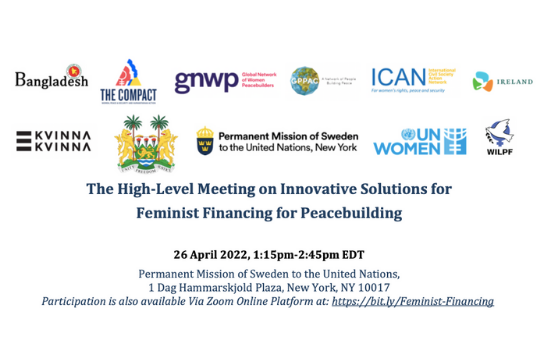
ICAN together with GPPAC, GNWP, Kvinna till Kvinna, Permanent Missions of Bangladesh, Ireland and Sweden to the United Nations, UN Women, WILPF and WPS-HA Compact cordially invite you to a high-level hybrid roundtable on Innovative Solutions for Feminist Financing for Peacebuilding, to take place on 26 April 2022 at 1:15-2:45pm EDT as part of discussions surrounding the High-Level Meeting on Financing for Peacebuilding.
We are a coalition of NGOs, academics, activists, women’s rights defenders, journalists, artists, filmmakers and peacebuilders. We are working to get our Afghan colleagues and families, who are under direct threat from the Taliban, to safety. They have worked to bring peace to Afghanistan over the last 20 years, have fought for the rights of all Afghans, and especially women, girls and minority groups in direct opposition to the Taliban. They now come to us for help because nobody came for them.
The February 1st military coup in Myanmar brutally crushed dissent, and the crackdowns and killings continue. In May another resurgence of violence in Palestine and Israel brought renewed attention to this 54-year conflict. How do social activists survive and thrive when the tanks roll in, the bombs drop, the raids and the arbitrary arrests begin? These, among other questions, were discussed on June 29th at the fifth session of the Coming of Age of the Women, Peace and Security Agenda series, entitled ‘Survival and Activism under Occupation’, focusing on Myanmar and Palestine.
Our fund disbursed $1 million in grants to 24 partners across 17 countries from Syria to Somalia, Colombia to Cameroon, Iraq to Indonesia & more Investing In Trust
Check out this 📽️ to see how ICAN's Innovative Peace Fund supported women peacebuilders' COVID19 response.