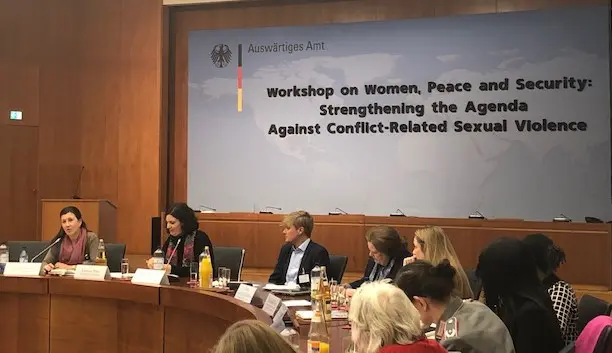
On 21-22 February 2019, ICAN’s Innovative Peace Fund Program Manager, France Bognon, participated in the “Workshop on Women, Peace and Security: Strengthening the Agenda Against Conflict-Related Sexual Violence.” The event, hosted and organized by the German Federal Foreign Office in Berlin, consisted of two days of annual workshops for Security Council members to address challenges and opportunities in implementing the Women, Peace and Security (WPS) agenda, and to discuss recent developments and share best practices and lessons learned. This included several panel discussions, as well as working group breakout sessions to provide an opportunity to deep dive into specific topics. Ms. Bognon was the Chair of the working group on the inclusion of civil society.
This year, the two-day workshop focused on conflict-related sexual violence (CRSV). There was a vibrant mix of participants, including from the UN system, field missions, regional organizations, member states, and international civil society. They worked to review existing infrastructures from a practitioner’s perspective, amplify a holistic approach of accountability, and discuss such emerging concepts as sexual violence against at-risk populations and men and boys, children born of wartime rape, CRSV as a tactic of terrorism, and the nexus between CRSV and small arms.
The civil society working group discussed the importance of civil society in promoting, implementing, and documenting a “survivor-centered approach” to CRSV. Other panelists of the working group included Jeannette Böhme, Advocacy and Human Rights Officer at Medica Mondiale, and Anouk Heili from UN Women Nigeria. Ms. Böhme framed her discussion around five pillars, originally designed by Medica Mondiale, that are central to implementing a “survivor-centered” approach. The working group agreed that these innovative pillars provided the framework for discussing the essential role of civil society in both promoting and implementing a ‘survivor-centered approach’.
First, efforts to combat CRSV must incorporate direct services, including psychosocial support, access to medicine and shelter, legal advice, and income-generating services. Services must be comprehensive, locally rooted, and sustainable in order to create long-term structures on the ground. For example, CSOs in Nigeria enabled access to comprehensive legal support and connected the judicial system with civil society to ensure a gender-sensitive approach.
Second, there is a continuum of violence in conflict. International actors, including state and non-state actors and civil society, can not only focus on violence as a strategic weapon of war, but must look at the root causes of violence. Which means ensuring that services targeting CRSV are inclusive of all forms of violence – not just rape in war-time, but also domestic and familial violence, and other forms of violence. One approach to this is to create men’s networks, which make men part of the solution and create solutions that are locally rooted and sustainable in the community. Any solution must work towards transformation of the individual and address the root causes of the inequality that leads to violence.
Third, we must take a multi-level approach by working at the societal level and with local, regional, and national governments. This includes providing direct services to survivors, families, communities, while also engaging political structures. Some examples include family mediation and solidarity groups that have been successful in Afghanistan and Liberia, respectively. In addition, we must engage the security sector to ensure accountability and work with local religious leaders to reduce stigma. In a district in Iraq, discussions with Imams led to the acceptance within society of children born of CRSV.
Fourth, it is imperative that development of any program includes consultations with local civil society, especially women-led Civil Society Organizations (CSOs), who know the needs and understand the context on the ground. They are best informed about the current conditions that perpetuate CRSV, and are most knowledgeable about who the on-the-ground experts are. As noted by Ms. Böhme, “feminist approaches recognize women’s expertise”. A representative from the UN Human Rights Council explained that victims are not single, homogenous groups, and programs to support them need to reflect that by being based in local needs. Approaches need to be gendered, informed by victims, holistic, accessible, and easy to understand.
Fifth, approaches to combat CRSV must be stress- and trauma-sensitive. Decisions must come from the survivor. To promote this, we must create a safe environment for survivors to express their concerns and needs, and to receive psychosocial support. Then, we must work towards empowerment and self-determination, promote social connection, and ensure the security and privacy of the survivor. Finally, it is critical to consider those that are on the ground doing this work. As such, there is a need for programs that promote self-care of these individuals to ensure their well-being and ability to continue their work.
Finally, in order to ensure that each of these pillars can stand on their own, all stakeholders, especially governments and donors, must make the following two guarantees: (1) to provide sufficient funding to local CSOs, especially through small, flexible grants, allowing them to not only build their own capacities, but to increase their impact on the ground; and (2) to commit to protecting the peacemakers, by guaranteeing their physical security, and giving them the political space and support they need to continue their work of building peace in their communities.